To view the new Data Store pages, click your profile icon. In the New UI section, turn on the Data Stores toggle.
Data snippets help you identify where Classification and Data tags appear across all of your data.
- Classification tags are used to classify types of data. Example tags include FINANCIAL, PCI, and PII.
- Data tags include entities and profiles. Example tags include CREDIT_CARD_NUMBER, EMAIL_ADDRESS, and PHONE_NUMBER.
Data snippets are supported for Azure and GCP data stores. To use snippets, you must update the Azure Onboarding version to v15 and the GCP Onboarding version to v7. In addition, snippets must be enabled in the Scan Scheduler as either Full or Mask.
Accessing Data Snippets
You can access data snippets whenever you see a Classification or Data tag in DSPM. For example, you can access data snippets on the Data Stores tab and the Data Store Classification tab. This gives you a quick, contextual view of your sensitive data without leaving the current page.
Azure and GCP data stores also have a Snippets tab.
To view data snippets, click a Classification or Data tag. The Data Snippets panel opens. The following example shows the data snippets for the “CREDIT_CARD_NUMBER” Data tag.
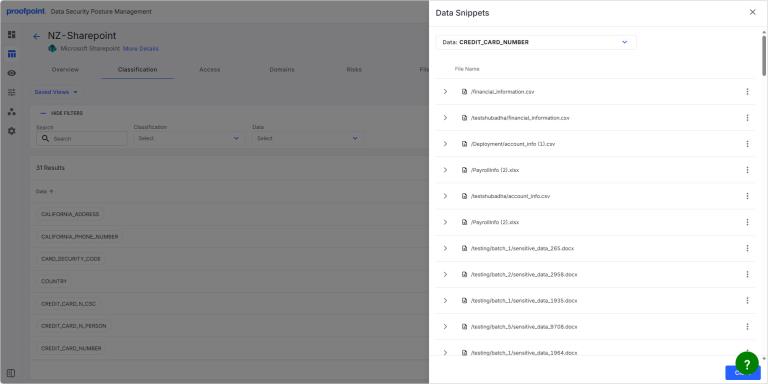
Use the list at the top of the panel to select a Classification or Data tag. When you select a tag, the locations where this sensitive data appears are listed as “snippets”.
Expand a snippet to view details, including:
- Filename of the file where the data was discovered.
- (Unstructured Data Stores Only) Database schema or file path.
- Name of the Classification or Data tag.
- A “snippet” of the file showing where the sensitive data appears in the file.
A maximum of 1000 snippets are shown in the Data Snippets panel.
Managing Classifications
Unstructured Data Stores (e.g., S3 Buckets)
For unstructured SaaS data stores, you can use the following options to choose which snippets are shown:
- Detected Show all classified data snippets.
- Ignored Show all snippets that have been manually ignored.
- All Show both detected and ignored snippets.
Ignore a Single Snippet Instance
To ignore a classification for a single snippet or file:
- Click
 beside a snippet, then select Ignore this file.
Ignore All Snippet Instances
If you determine that the classification is a false positive, you can choose to ignore the classification for all snippets of that type within the data store.
- Select the Ignore all checkbox, then click Apply.
Structured Data Stores (e.g., Databases, Tables, Columns)
When viewing data snippets for structured data, you can choose to ignore classifications at different levels.
Ignore a Single Snippet Instance
To ignore a classification for a specific snippet:
- Click beside a snippet, then select Ignore at Column level. This will ignore the classification for that specific column instance.
Ignore All Snippet Instances
To ignore all instances of a specific data class:
- Click beside a snippet.
-
Select one of the following options:
- Ignore at Column level Ignores the classification for all instances of this data class within the specific column you are viewing.
- Ignore at Table level Ignores the classification for all instances of this data class within the entire table you are viewing.
- Ignore at Database level Ignores the classification for all instances of this data class within the entire database you are viewing.
- Unignore all snippets Reverts any previous “Ignore” actions for this data class within the current scope.
- Click Apply.